


Decking Innovations Cape Town: 7 Global Trends for 2026
Outdoor living is part of the Cape Town lifestyle. A well-designed deck can connect a home to its garden, swimming pool, mountain view or entertainment area—but local conditions can be demanding.
Strong summer UV, salt-laden coastal air, wet winters, wind and regular temperature changes all affect how decking performs. That is why homeowners are looking beyond appearance and asking better questions: Will the surface become uncomfortably hot? Will it fade or move? How much maintenance will it require? What happens to the structure underneath the boards? International decking manufacturers are responding with smarter materials and complete installation systems rather than simply introducing new colours. Some of these products are already influencing the South African market, while others provide an early look at what could be coming next. Here are seven of the most important global decking innovations Cape Town homeowners, architects and property developers should watch in 2026.1. Composite Decking Designed to Stay Cooler
Heat retention has traditionally been one of the biggest concerns surrounding composite decking, especially in exposed pool areas where people walk barefoot. The latest overseas products use heat-mitigating cap layers and infrared-reflective technology to reduce the amount of solar energy absorbed by the board. For example, Trex SunComfortable technology is engineered to stay cooler than the company’s original boards under comparable test conditions. This is an important development for Cape Town, but it does not mean any decking surface will remain cool in full summer sun. Board colour, orientation, ventilation and the length of sun exposure still matter. Lighter natural shades generally absorb less heat than charcoal or very dark brown finishes. For exposed patios and pool surrounds, homeowners should ask about:
- Comparative surface-temperature testing
- The colour’s effect on heat absorption
- UV and fade warranties
- Wet slip resistance
- Whether the heat-performance claim applies to the exact product and colour selected

2. Mineral-Based Composite Decking
Traditional wood-plastic composite generally combines wood fibre with plastic. A newer overseas category replaces the organic wood component with a mixture of polymers and mineral fillers. Deckorators Surestone technology is one example. According to the manufacturer, its mineral-based boards absorb virtually no moisture, have very low thermal movement and are approximately 35% lighter than many conventional composite boards. Certain boards in the range are also warranted for installation in contact with the ground or water. The concept could be particularly useful for:- Pool decks and splash zones
- Coastal properties
- Low-clearance decks where airflow is restricted
- Docks and other water-adjacent applications
- Projects where board weight is a concern
3. Composite That Looks More Like Genuine Timber
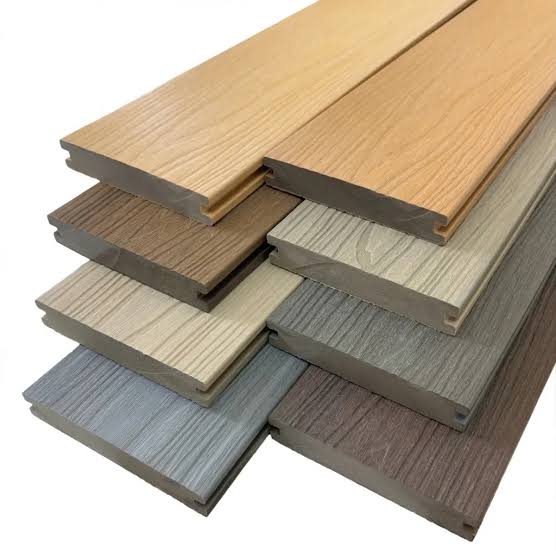
Composite decking has often been easy to identify because of repeated grain patterns, glossy finishes and uniform colouring. That is changing quickly. New-generation boards use more sophisticated embossing, colour variation, matte finishes and non-repeating patterns to reproduce the character of cedar, oak and tropical hardwoods. Fiberon’s Novus decking, introduced in 2026, uses captured timber imagery fused to a composite core and a thermoset protective shell designed to improve scratch and dent resistance. For Cape Town homeowners, this means the choice between timber and composite is becoming less about appearance alone. It is increasingly about the experience the client wants:- Genuine timber offers natural variation, warmth and an appearance that changes over time.
- Premium composite offers a more controlled appearance and generally lower routine maintenance.
- Modern surface technology is narrowing the visual difference between the two.
4. Greater Focus on Fire-Conscious Decking
Wildfires in the United States and bushfires in Australia have accelerated the development of decking with improved ignition and flame-spread performance. Some overseas PVC ranges now carry Class A flame-spread ratings and ignition-resistant designations, while Australian companies are manufacturing non-combustible, timber-look aluminium systems for high-risk bushfire zones. TimberTech provides a useful explanation of the distinction between fire-resistant decking and different flame-spread classifications. This development is relevant to Western Cape homes situated near mountains, greenbelts and fynbos. However, fire resistant does not mean fireproof, and an overseas certification does not automatically demonstrate compliance with South African regulations. A fire-conscious deck design should consider the entire assembly:- Surface boards
- Subframe and supporting structure
- Gaps where embers or combustible debris can collect
- Fixings and edge details
- Position of braais, fire features and other heat sources
- Defensible space and surrounding vegetation
5. Thermally Modified Timber and High-Density Bamboo
Not every innovation involves plastic or aluminium. There is growing international interest in natural materials that have been modified to improve durability and stability. Thermally modified timber is treated using carefully controlled heat and steam. This changes the wood throughout the board, reducing its tendency to absorb moisture, swell and shrink. It retains the warmth of real timber and can be left to weather naturally to a silver-grey colour. This is especially relevant locally because Decking Pro already works with Lunawood Thermowood decking, providing Cape Town clients with access to a proven modified-timber option. High-density bamboo is another category developing overseas. Strips of bamboo are thermally treated and compressed into dense exterior boards. Current ranges include hidden-fixing profiles, long boards, pre-weathered colours and patterned layouts such as chevron. Modified timber and bamboo can provide an alternative to tropical hardwood, but correct installation remains essential. Ventilation, board spacing, end sealing, compatible fixings and the manufacturer’s maintenance instructions all influence long-term performance.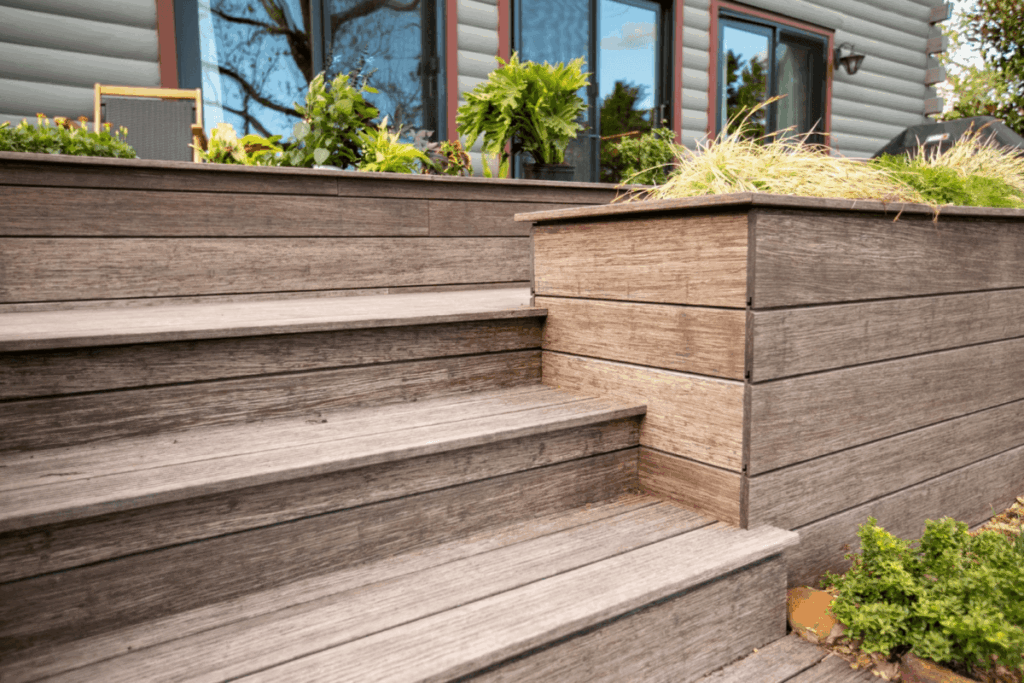
6. Aluminium Substructures and Removable Hidden Fixings
One of the most practical innovations is happening underneath the deck. Potential benefits include:- Faster and more consistent installation
- Straight, accurately spaced board lines
- No visible screws on the surface
- Improved resistance to subframe rot
- Easier removal of individual boards for repairs or access to services
- Suitability for balconies, rooftops and complicated levels
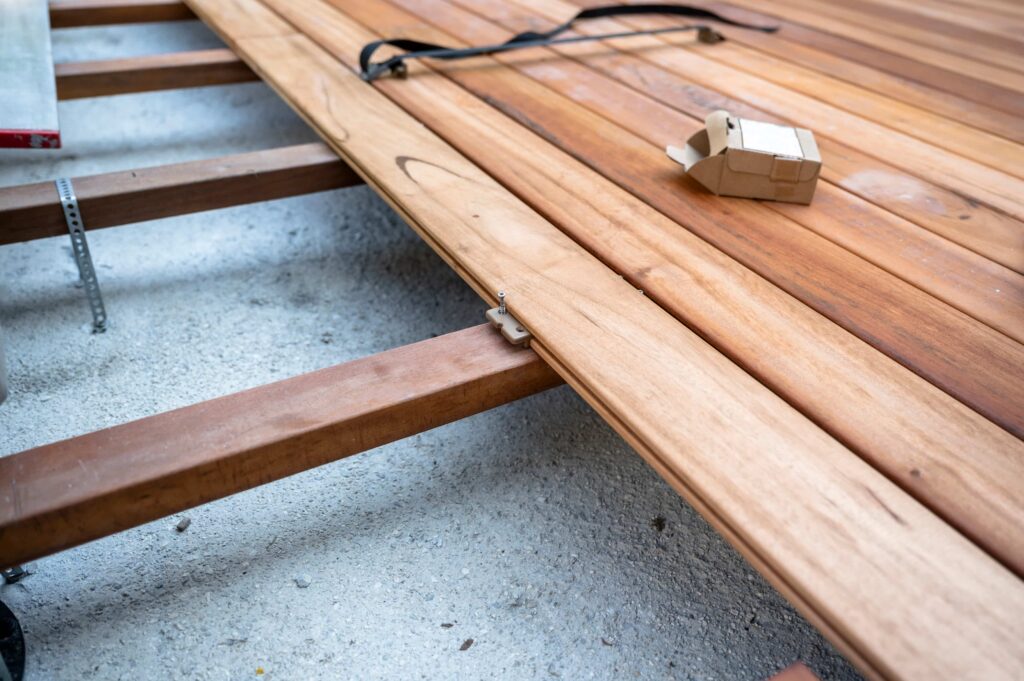
Close-up view of wooden deck boards being installed using hidden fasteners on a subframe. The image shows a construction phase with tools and materials, suitable for illustrating DIY, renovation, or carpentry work.
7. Decks That Do More: Dry Spaces, Movable Decks and Solar Surfaces
International design is treating a deck as usable infrastructure rather than a simple outdoor floor. Under-deck drainage systems collect and redirect water, helping to protect the substructure while creating a dry entertainment, storage or parking area beneath an elevated deck. This is valuable on smaller properties where every square metre needs to work harder. Movable systems are also becoming more sophisticated. A well-designed sliding pool deck can provide a load-bearing pool cover and an additional entertainment surface when the pool is not being used. At the experimental end of the market, walkable photovoltaic tiles are turning terraces and decks into energy-generating surfaces. PLATIO Solar Deck combines solar cells with a load-bearing, anti-slip glass surface that can be integrated with timber, composite or paving. Solar decking is still a specialist product and is unlikely to replace conventional rooftop solar for most Cape Town homes. However, it could eventually suit premium rooftops, marinas, hotels and commercial outdoor spaces where conventional panels are impractical.The Decking Design Trends Accompanying These Innovations
The technology may be changing, but appearance remains important. The strongest international design trends for 2026 include:- Warm, natural timber colours instead of cold grey
- Matte and low-gloss finishes
- Mixed-width boards and contrasting picture-frame borders
- Curved edges that connect more naturally with landscaping
- Composite decking paired with stone, glass or aluminium
- Defined zones for dining, lounging, braaiing and relaxing
- Built-in seating, concealed storage and integrated lighting
- Flush transitions between indoor and outdoor living areas
- Pergolas, screens and shade incorporated into the original deck design
Which Innovations Make the Most Sense for Cape Town?
The most useful innovation is not necessarily the newest or most expensive. It is the one that solves the property’s actual exposure and lifestyle requirements. For many Western Cape projects, the strongest priorities are likely to be:- Cooler, lighter-coloured boards for sunny pool and entertainment areas.
- UV-stable, moisture-resistant materials for coastal properties.
- Aluminium or correctly treated substructures with corrosion-resistant fixings.
- Concealed fastening systems for a clean, barefoot-friendly finish.
- Modified timber for clients who want real wood with greater stability.
- Under-deck drainage or sliding systems that create additional usable space.
- Fire-conscious materials and detailing for homes close to vegetation.